Learning from innovative businesses about creating a culture of experimentation in government: An interview with Jim Manzi, Author of “Uncontrolled” – Episode #17
 How can public agencies use a test, learn and adapt approach to improve their results? One way is to learn from leading private sector firms that use rapid experimentation to learn what works and improve their operations.
To learn more we are joined by Jim Manzi, the founder and chairman of Applied Predictive Technologies, a business analytics firm. His 2012 book Uncontrolled: The Surprising Payoff of Trial-and-Error for Business, Politics and Society argues for the usefulness of experimental methods—in other words, randomized controlled trials (RCTs)—for addressing important policy issues, from improving education outcomes to increasing economic growth to reducing crime.
In a review of Uncontrolled in the New York Times, columnist David Brooks writes, “Manzi wants to infuse government with a culture of experimentation.” Brooks also notes: “What you really need to achieve sustained learning, Manzi argues, is controlled experiments. Try something out. Compare the results against a control group. Build up an information feedback loop. This is how businesses learn. By 2000, the credit card company Capital One was running 60,000 randomized tests a year — trying out different innovations and strategies. Google ran about 12,000 randomized experiments in 2009 alone.”
 Steve Aos is the Director of the
  Mike Powell is the Chief Innovation Officer for the State of Maryland under Governor Martin O’Malley. In that role, he helps oversee the
  Amelia Showalter served as Director of Digital Analytics on Barack Obama’s 2012 presidential campaign, leading a team that designed and implemented hundreds of experiments to improve the performance of all types of digital outreach. Today, she is a
  Matt Leighninger is the Executive Director of the Deliberative Democracy Consortium and the author of the recent report for public managers, “
 Almost half of all pregnancies in the United States are unintended and the women and children involved in these pregnancies are disproportionately likely to experience a range of negative outcomes. For insights into cost-effective policy strategies to reduce unintended pregnancy, my guest is Adam Thomas, a professor at Georgetown University and the former Research Director for the Brookings Institution’s Center on Children and Families. His recent article in the Journal of Policy Analysis and Management — as well as a
  Jeff Tryens is the Deputy Director for Performance Management in the Mayor’s Office in New York, under Michael Bloomberg. He is responsible for reporting overall city government performance and initiating cross-agency performance improvement initiatives. Prior to that role, Jeff was the Executive Director of the
  The U.S. Department of Housing and Urban Development (HUD) has 9,000 employees and a $46 billion budget. How does the agency focus its numerous staff and diverse programs on critical goals? It uses HUDStat, launched in 2010.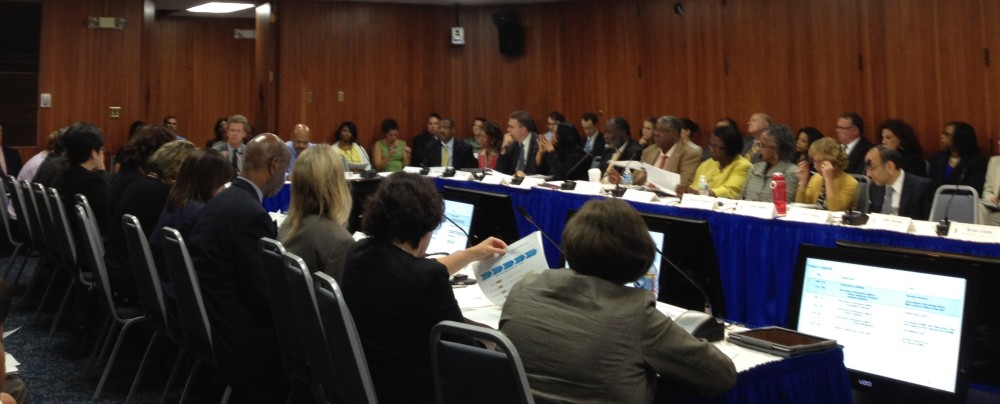
 A growing trend among cities and states in the U.S. is outcome budgeting. Baltimore began using